What Is a Line-Interactive UPS and How Does It Work?
Introduction
Power interruptions and voltage fluctuations can affect the operation of servers, network equipment, and other business-critical electronics. Even a brief outage may interrupt business activities, while unstable input voltage can affect equipment performance and reliability.
An uninterruptible power supply (UPS) helps address these risks by providing backup power and regulating the electricity supplied to connected devices. However, different UPS topologies use different methods to manage incoming power and respond to electrical disturbances.
A line interactive UPS is commonly used in small and medium-sized business environments because it combines voltage regulation with battery backup. Understanding how this technology works, what its main components do, and where it is most suitable can help IT managers and equipment buyers make more informed purchasing decisions.
What Is a Line-Interactive UPS?
A line-interactive UPS is a type of uninterruptible power supply that provides backup power while helping regulate fluctuations in the incoming utility voltage.
Under normal operating conditions, connected equipment generally receives power from the utility supply through the UPS. An automatic voltage regulation (AVR) system adjusts certain voltage variations without requiring the battery to supply power every time the input voltage changes.
When the utility supply fails or becomes unsuitable, the UPS switches to battery operation to maintain power to connected equipment.
This operating approach makes a line-interactive UPS different from a standby UPS and an online double-conversion UPS.
A standby UPS mainly switches to battery power when an input power problem occurs. An online double-conversion UPS continuously converts incoming AC power to DC and then back to AC, providing a different level of power conditioning.
By comparison, the line-interactive design offers a balance between voltage regulation, backup capability, and system complexity. It is often considered for office IT equipment, small business servers, network devices, and other applications that need dependable backup power.
How Does a Line-Interactive UPS Work?
The operation of a line-interactive UPS can be understood through three main stages: normal power supply, voltage regulation, and battery backup.
1. Normal Power Supply
When utility power is available and remains within the acceptable operating range, electricity passes through the UPS to the connected equipment.
During this stage, the battery is maintained through the UPS charging system. The inverter is also part of the power conversion system, but it does not continuously supply the load in the same way as an online double-conversion UPS.
This arrangement allows the system to provide backup capability without relying on continuous battery operation.
2. Automatic Voltage Regulation
Utility voltage does not always remain stable. It may rise above or fall below its normal level because of grid conditions, changes in electrical demand, or other disturbances.
A line-interactive UPS uses AVR to correct certain overvoltage and undervoltage conditions. Depending on the design, the system can adjust the voltage supplied to connected equipment without immediately switching to battery power.
This helps reduce unnecessary battery use during voltage fluctuations and keeps the equipment supplied with a more suitable input voltage.
3. Battery Backup During a Power Failure
When utility power is interrupted, the UPS switches to its battery supply.
The battery provides DC power to the inverter, which converts it into AC electricity for connected equipment. This allows essential devices to continue operating for a limited period after the main power source becomes unavailable.
The available backup time depends on several factors, including the connected load, battery capacity, battery condition, and operating environment.
For IT administrators, this backup period can provide valuable time to save work, maintain essential operations temporarily, or perform a controlled system shutdown.
What Role Does AVR Play in a Line-Interactive UPS?
Automatic Voltage Regulation is one of the main features that distinguishes a line-interactive UPS from a basic standby design.
Voltage fluctuations can occur even when there is no complete power outage. For example, low input voltage may occur when electrical demand increases, while higher voltage conditions may appear when the load on the electrical supply decreases.
Without appropriate regulation, connected equipment may experience repeated changes in its input voltage.
AVR addresses these conditions by adjusting the voltage through an internal regulation mechanism, commonly using a transformer with different voltage adjustment levels.
Its main benefits include:
- Voltage correction: Helps compensate for certain high and low input voltage conditions.
- Reduced battery usage: Corrects supported voltage fluctuations without relying on battery power.
- Improved power availability: Helps maintain a more stable supply for connected equipment.
- Battery preservation: Reduces unnecessary battery cycling during normal voltage variations.
However, AVR does not replace battery backup or protect against every possible electrical disturbance. Its correction range depends on the specific UPS design and model.
What Happens When a Line-Interactive UPS Switches to Battery Power?
When the incoming utility supply fails or moves outside the UPS operating limits, the system changes from utility-powered operation to battery-powered operation.
This process involves several components:
- Battery: Stores electrical energy for use during a power interruption.
- Inverter: Converts the battery’s DC power into AC output.
- Control system: Detects input power conditions and manages the transition between operating modes.
- Output circuit: Delivers backup power to connected equipment.
The transition is not always instantaneous. Line-interactive UPS systems have a transfer time when changing to battery operation. Connected equipment must be able to tolerate this brief interruption.
For this reason, buyers should consider equipment compatibility and the UPS transfer characteristics when selecting a power protection solution.
The inverter’s output waveform is another important consideration. Sensitive electronic equipment and servers with active power factor correction (PFC) power supplies may benefit from a pure sine wave output.
Where Are Line-Interactive UPS Systems Commonly Used?
Line-interactive UPS systems are suitable for applications that need voltage regulation and temporary backup power without necessarily requiring the continuous power conversion of an online UPS.
Common applications include:
Small Business Servers
Servers support business applications, databases, file storage, and internal systems. A suitable UPS helps maintain power during short interruptions and provides time for an orderly shutdown when necessary.
Network Equipment
Routers, switches, and communication devices are important parts of business network infrastructure. A UPS can help maintain network availability during power disturbances, depending on the connected load and backup capacity.
Office IT Infrastructure
Desktop computers, workstations, and other office electronics may require backup power to reduce unexpected interruptions and protect ongoing work.
Point-of-Sale Systems
Retail POS equipment handles sales transactions and related business information. Backup power can help reduce disruption when the main electricity supply is interrupted.
When selecting a UPS for these applications, buyers should consider equipment power consumption, required backup time, output waveform, available connections, and the expected operating conditions.
What Should Buyers Consider When Choosing a Line-Interactive UPS?
Choosing a suitable UPS requires more than comparing its rated capacity. Several technical and practical factors should be evaluated before purchasing.
1. Power Capacity
UPS capacity is commonly expressed in volt-amperes (VA) and watts (W). VA represents apparent power, while watts represent real power. Buyers should check both ratings and ensure that the UPS can support the combined power demand of connected equipment.
2. Output Waveform
The output waveform affects compatibility with connected electronics. A pure sine wave output can be particularly relevant for modern servers and equipment using active PFC power supplies.
3. Voltage Regulation Range
Check the input voltage range supported by the UPS and how its AVR system responds to high and low voltage conditions. This helps determine whether the unit is suitable for the electrical environment.
4. Battery Runtime
Backup time varies according to the connected load and battery condition. Buyers should compare runtime information at different load levels rather than relying on a single maximum runtime figure.
5. Output Connections and Management
The number and type of output outlets should match the equipment being connected. USB, serial communication, and display functions can also help IT teams monitor power conditions and manage the UPS.
These considerations help businesses select a UPS power supply that matches their actual equipment requirements rather than choosing a model based on capacity alone.
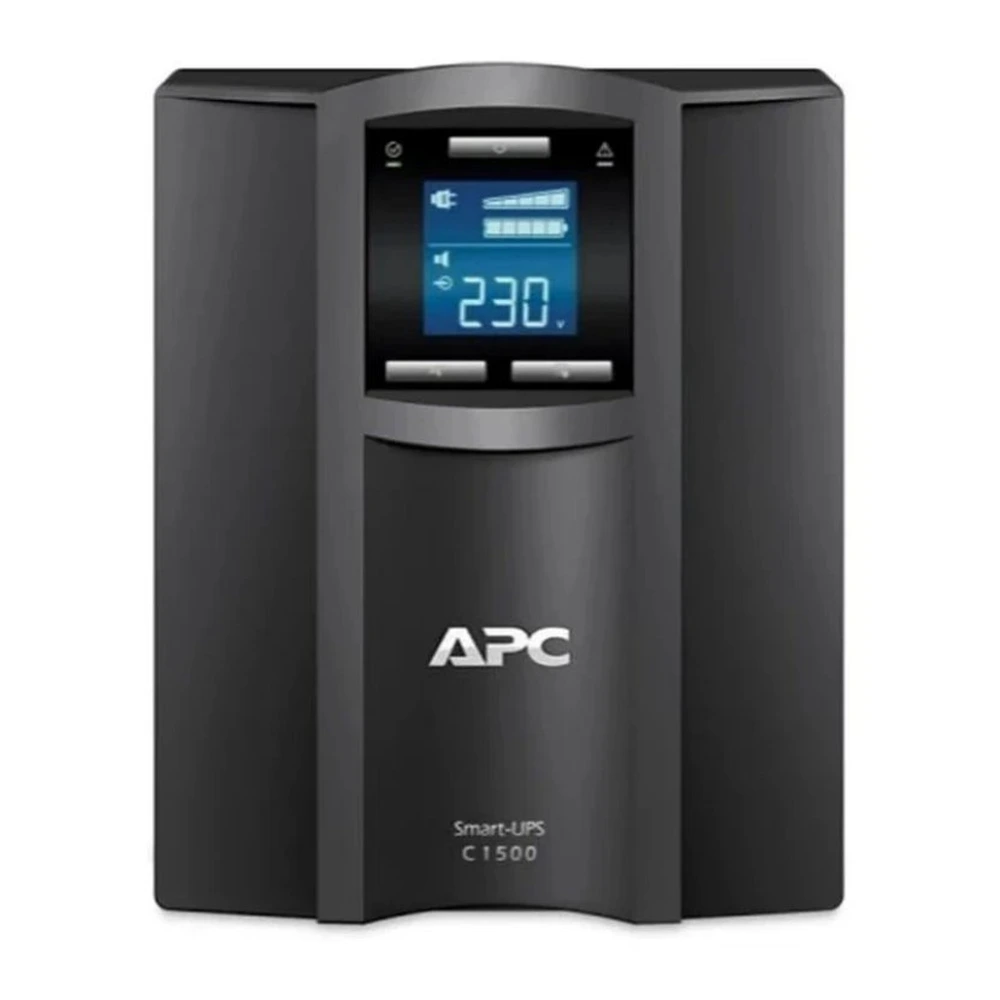
APC Smart-UPS SMC1500I-CH: A Line-Interactive UPS for Business IT Equipment
For businesses looking for a line-interactive UPS for servers, storage systems, and network equipment, the APC smart line interactive ups is one model worth considering.
This tower-type UPS combines voltage regulation, pure sine wave output, and built-in battery backup for small and medium-sized business IT environments.
Key Features and Specifications
1500VA / 900W Power Capacity
The SMC1500I-CH provides a rated capacity of 1500VA and 900W. This gives buyers two important reference values when evaluating whether the UPS can support their connected equipment.
Pure Sine Wave Output
The unit provides 230V sine wave output, with less than 5% output voltage distortion at full load. This supports compatibility with sensitive electronic equipment, including servers with active PFC power supplies.
Automatic Voltage Regulation
Its AVR system corrects high and low input voltage conditions within a specified range of 180V–287V. It also provides 455 Joules of surge protection without draining the battery during supported voltage correction.
Built-In Lead-Acid Battery
The UPS uses a sealed lead-acid battery. Its temperature-compensated charging system adjusts charging voltage according to battery temperature to support battery service life.
Backup Runtime
The typical runtime is approximately 14.4 minutes at half load and 4.7 minutes at full load. Actual runtime depends on operating conditions and connected equipment.
LCD Display and Communication Interfaces
The LCD interface provides information about mains power, battery capacity, estimated runtime, output frequency, and load rate. USB and Serial (RJ-45) communication ports are also available for power management.
Output Connections and Efficiency
The unit features eight IEC 320 C13 output receptacles and an IEC 320 C14 input connection. Its full-load efficiency is rated at 96%.
The tower enclosure measures 219 × 171 × 439 mm (H × W × D), with a net weight of 24.04 kg.
Conclusion
A line-interactive UPS combines voltage regulation and battery backup to help protect electronic equipment from common power disturbances. Its AVR function corrects supported voltage fluctuations, while the battery and inverter provide temporary AC power when utility electricity becomes unavailable.
For businesses, selecting the right system means evaluating power capacity, output waveform, voltage regulation, runtime, and management interfaces according to actual equipment requirements.
The APC Smart-UPS SMC1500I-CH offers a 1500VA/900W capacity, pure sine wave output, AVR, and built-in lead-acid battery backup. If you are evaluating UPS solutions for servers, networking equipment, or office IT infrastructure, contact our team to discuss your power requirements and find a suitable configuration.
Frequently Asked Questions
1. What Is the Main Difference Between a Line-Interactive UPS and an Online UPS?
A line-interactive UPS uses AVR to regulate voltage and switches to battery power when necessary. An online UPS continuously converts AC power to DC and back to AC, providing continuous power conditioning.
2. Does a Line-Interactive UPS Provide Pure Sine Wave Output?
Some line-interactive UPS models provide pure sine wave output, while others use different waveforms. Buyers should check the output specifications to ensure compatibility with their connected equipment.
3. How Long Can a Line-Interactive UPS Provide Backup Power?
Backup runtime depends on the UPS capacity, connected load, and battery condition. A higher load generally results in a shorter runtime, so buyers should check runtime specifications at their expected operating load.