What Should Distributors Consider When Sourcing Long Backup Rack Mount UPS Systems?
For distributors, IT equipment suppliers, and system integrators, sourcing a suitable uninterruptible power supply involves more than comparing rated capacity and purchase price. Business customers often need reliable power protection, sufficient backup time, flexible installation, and convenient equipment management. These requirements become especially important when supplying telecommunications equipment, server racks, and other critical IT infrastructure.
A long backup rack mount UPS is designed to meet situations where standard battery configurations may not provide the required runtime. When evaluating different solutions, distributors need to understand how the UPS works, how external batteries affect backup time, and whether the equipment matches the customer’s installation and power requirements.
This guide explains the main factors to consider when sourcing long backup rack mount UPS systems for commercial and industrial applications.
1. Understand the Required UPS Capacity
The first step in selecting a UPS is determining the actual power demand of the connected equipment. Servers, routers, switches, and other electronic devices may have different power requirements, so distributors should evaluate the total load before recommending a suitable unit.
Two ratings are commonly used when comparing UPS capacity:
- VA (Volt-Ampere): Represents the apparent power capacity of the UPS.
- W (Watts): Represents the actual active power that the UPS can supply to connected equipment.
These ratings are related but are not interchangeable. A UPS with a higher VA rating does not necessarily provide the same amount of usable wattage.
For example, a business purchasing an online UPS 1kVA should check both the VA and watt ratings against the connected load. Choosing a unit based only on its VA rating may result in insufficient output capacity.
For distributors handling different customer projects, collecting the equipment list and estimated power consumption is a practical starting point. It helps narrow down suitable models and reduces the risk of recommending an undersized UPS.
2. Evaluate External Battery Configuration and Backup Time
Backup time is another important consideration when sourcing a long backup UPS. While some UPS systems include built-in batteries, other models are designed to operate with external battery banks.
An external battery configuration gives businesses more flexibility when determining their backup requirements. Instead of relying on a fixed internal battery capacity, users can select an external battery bank based on the expected load and required runtime.
Before sourcing an external battery UPS, distributors should consider several factors:
Battery Voltage Compatibility
The external battery voltage must match the UPS requirements. Connecting an incompatible battery system can affect normal operation and may damage the equipment.
Battery Capacity
Battery capacity, usually expressed in ampere-hours (Ah), is an important factor in determining available backup energy. A higher capacity battery bank can generally provide longer backup time under comparable operating conditions.
Connected Load
Backup duration also depends on the actual power consumption of connected equipment. A higher load uses battery energy more quickly, reducing the available runtime.
Installation and Maintenance
External battery banks require appropriate installation space, electrical connections, and maintenance arrangements. Distributors should understand these requirements before recommending a complete backup solution.
It is also important to avoid promising a specific backup duration without considering the battery configuration and actual load. The required runtime should be evaluated for each project rather than estimated from the UPS capacity alone.
3. Check Rack Compatibility and Installation Requirements
For businesses managing server rooms, network cabinets, and telecommunications infrastructure, installation space is often limited. A rack mount UPS allows power protection equipment to be integrated into the same cabinet as other IT devices.
When evaluating a rack mount UPS, distributors should check the following details:
- Rack size: Confirm whether the UPS is compatible with the customer’s rack dimensions, including standard 19-inch rack requirements where applicable.
- Rack height: Check the number of rack units (U) required for installation.
- Physical dimensions: Consider the width, depth, and height to ensure sufficient installation space.
- Weight: Check the equipment weight and confirm that the rack can support the installation.
- Cable arrangement: Make sure the available space allows practical access to input, output, and battery connections.
A rackmount UPS can help organize power protection equipment within an existing IT cabinet. However, compatibility should always be confirmed using the actual dimensions and installation conditions rather than relying on the rack-mounted design alone.
4. Consider Power Protection Technology
The UPS operating technology affects how connected equipment receives power during normal operation and electrical disturbances.
Online double-conversion UPS systems are commonly selected for applications that require continuous power conditioning. They convert incoming AC power into DC power and then convert it back into AC power for connected equipment.
This process provides several important characteristics:
Zero Transfer Time
Online double-conversion systems supply power through the conversion process rather than switching between utility power and inverter output during a normal power interruption. This eliminates transfer time during the transition to battery operation.
Pure Sine Wave Output
A pure sine wave output provides an AC waveform suitable for many electronic devices, including servers, communication equipment, and other sensitive loads.
Input Voltage Range
The acceptable input voltage range is another factor to evaluate. A wider range allows the UPS to operate across a broader range of incoming voltage conditions without immediately relying on battery power.
For distributors, understanding these features makes it easier to match UPS technology with the customer’s power protection requirements.
5. Evaluate Monitoring and Communication Interfaces
For businesses managing multiple network devices or equipment racks, monitoring capabilities can make daily UPS management more convenient.
When comparing UPS systems, distributors should examine the available communication interfaces and optional monitoring functions.
Common considerations include:
- LCD display: Provides local access to operating status and configuration information.
- RS232 and USB: Allow communication between the UPS and connected management equipment.
- SNMP support: Optional network monitoring can help administrators observe UPS status remotely.
- Modbus support: Can be useful when UPS monitoring needs to be integrated into compatible management systems.
Not every project requires the same monitoring configuration. Some customers may only need local status information, while others may require network-based monitoring across their IT infrastructure.
Distributors should confirm which interfaces are included as standard and which functions require additional communication cards.
6. APC SP Series SPRM1KL: A Long Backup Rack Mount UPS Option
For distributors and system integrators looking for a compact online rack UPS with an external battery configuration, the APC SP Series SPRM1KL is one option to consider.
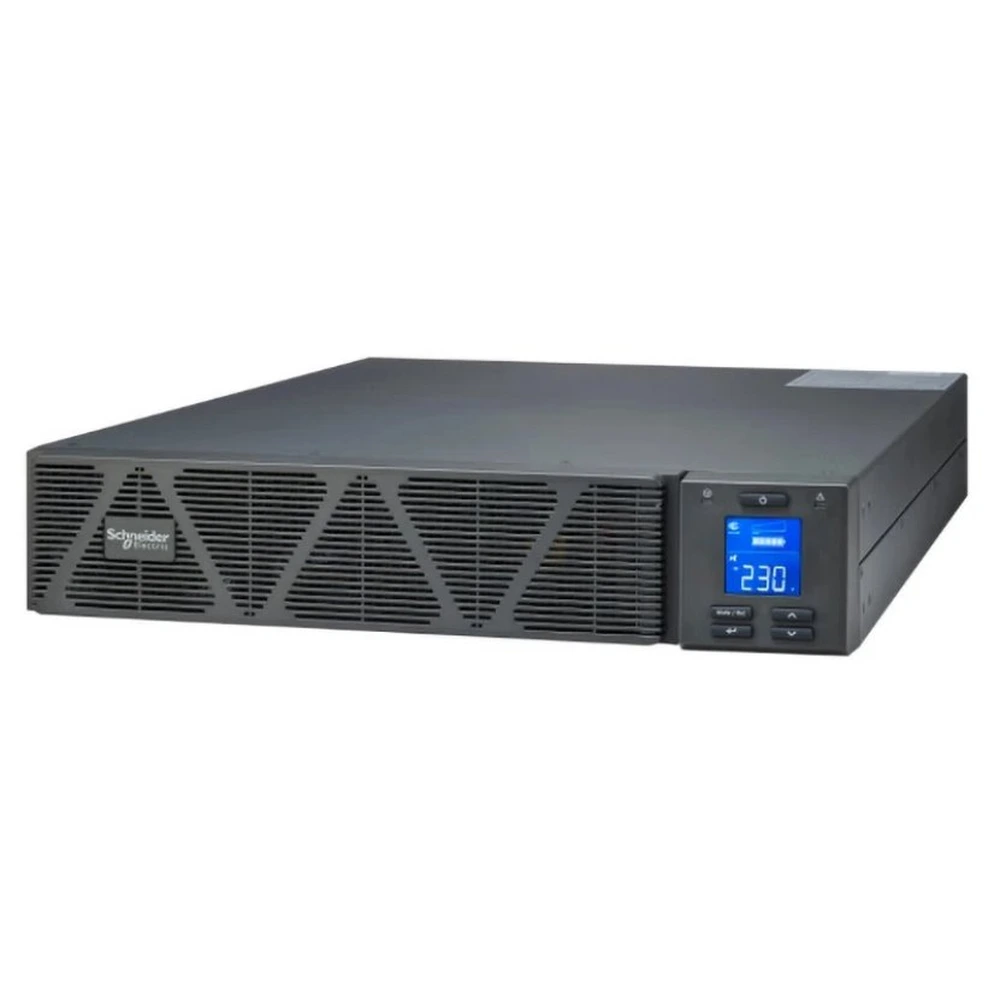
The SPRM1KL is a 1000VA/800W online rack mount UPS designed without built-in batteries. It connects to an external 36V battery system, allowing users to configure backup capacity according to their application requirements.
Its main features include:
External Battery Configuration
Unlike standard UPS models with built-in batteries, the 1kva ups rack mount uses an external 36V battery system. The actual backup time depends on the capacity of the connected external batteries.
This configuration is relevant for projects where customers need to determine their own battery capacity based on expected runtime.
2U Rack Mount Design
The unit measures 438 × 332 × 88 mm and occupies 2U of vertical rack space. Its standard rack-type design supports installation in compatible 19-inch IT racks.
With a net weight of 6.3 kg, it also offers a relatively lightweight UPS chassis for rack installation.
Online Double-Conversion Technology
The SPRM1KL uses online double-conversion technology with zero transfer time and pure sine wave output. Its input voltage range is 110–300VAC, while the default output voltage is 220VAC, with 230VAC and 240VAC options.
Communication and Monitoring
The unit includes an LCD interface, RS232, and USB communication ports. Its smart card slot supports optional SNMP, Modbus, or environmental monitoring cards.
Output Connections
The UPS provides four national standard output sockets. Its input connection uses an IEC C14 connector with a 10A protector.
The SPRM1KL is listed for telecommunications, data centers and IT closets, industrial automation, security, and lighting applications.
For distributors comparing different rackmount UPS solutions, this model offers a combination of external battery flexibility, compact installation, and online power protection.
Conclusion
Sourcing a long backup rack mount UPS requires distributors to evaluate more than rated capacity. External battery compatibility, expected backup time, rack dimensions, power protection technology, and monitoring interfaces all influence whether a UPS is suitable for a particular project.
By understanding these factors, distributors and system integrators can make more informed purchasing decisions and provide solutions that match their customers’ actual requirements.
The APC SP Series SPRM1KL offers a 1000VA/800W online UPS configuration with a 36V external battery system and a compact 2U rack design. Contact our team to learn more about the SPRM1KL and discuss its specifications for your UPS sourcing requirements.
Frequently Asked Questions
1. What Is a Long Backup Rack Mount UPS?
A long backup rack mount UPS is a rack-mounted uninterruptible power supply designed to work with external battery banks. It allows users to configure battery capacity according to their backup time requirements.
2. How Do Distributors Choose the Right Battery for a Rack Mount UPS?
Distributors should check the UPS battery voltage requirements, connected load, battery capacity, and expected backup time. Battery compatibility is essential for safe and reliable operation.
3. What Are the Main Benefits of an Online Rack Mount UPS?
An online rack mount UPS provides continuous power conditioning through double-conversion technology. It offers zero transfer time and pure sine wave output, making it suitable for protecting sensitive IT and telecommunications equipment.