300kVA UPS Selection Guide: Key Factors for Large Facilities
Introduction
A power outage at a large facility is not an inconvenience; it is a measurable risk. Server halls, hospital wings, and manufacturing floors all depend on a supply that stays within tight voltage and frequency limits, even when the grid does not. For sites drawing hundreds of kilowatts, the decision of which uninterruptible power supply to install is one of the most consequential infrastructure choices a facility manager makes.
This guide explains the principles behind large-scale UPS selection. It covers how these systems protect loads, why topology matters, what efficiency means in practice, and which application factors should drive the specification. The product section that follows applies those principles to one concrete example.
How a UPS Protects Critical Loads
A UPS does two things at once. It conditions incoming power so that voltage sags, swells, and harmonic distortion never reach the load, and it provides a bridge to backup power when the mains fail entirely. In a large facility, that bridge must be long enough to cover the start-up sequence of a generator set, or in some cases to carry the load until the grid returns.
The size of the bridge is measured in both power and time. Power is the load the UPS can support at any moment; time is the battery capacity that determines how long it can do so. A 300 kva ups sits at the upper end of the commercial range, capable of supporting dense IT racks, MRI suites, or entire building services without derating. The key is matching the UPS rating to the actual load profile, not just the peak demand.
Why Topology Matters: Online vs Line-Interactive
UPS designs fall into two broad families. Line-interactive units switch to battery when the mains drifts outside an acceptable window. They are compact and economical, but the load sees the disturbance for a few milliseconds before the transfer completes. For servers, medical imaging, and precision controls, that gap can be enough to cause a fault.
An online ups takes a different approach. The load is always fed by the inverter, which draws power from the mains while they are healthy and from the battery the instant they are not. There is no transfer time, no switching transient, and no moment when the load is exposed to raw grid conditions. For large facilities where downtime is measured in thousands of dollars per minute, online topology is the standard reference.
Double Conversion: The Reference Standard for Large Sites
Within the online family, the most common architecture is double conversion. Incoming AC is rectified to DC, the DC charges the battery and feeds the inverter, and the inverter regenerates clean AC for the load. The load is electrically isolated from the grid at all times.
A ups double conversion design offers the tightest output regulation and the cleanest waveform. It also provides a stable DC bus that can accept a wide range of input voltages without switching to battery, which reduces battery cycling and extends service life. The trade-off is energy loss in the rectifier and inverter. Modern designs have narrowed that loss dramatically, but efficiency still varies by model and operating mode, and it directly affects both electricity bills and cooling load.
What Facility Managers Should Look for in UPS Systems
Selecting a unit means looking past the headline kVA rating. A complete evaluation should cover several practical dimensions.
Power Factor and Real Power
The kVA rating describes apparent power; the kilowatt rating describes real power that actually does work. Modern IT power supplies draw current with a near-unity power factor, which means apparent and real power are close to equal. A UPS rated at 300 kVA but only 240 kW will leave usable capacity on the table if the load power factor is high. Matching the kW rating to the actual load avoids both under-utilisation and the need to oversize.
Efficiency and Operating Modes
Efficiency in online mode typically ranges from 93% to 97%. The gap between 93% and 96% may seem small, but at 300 kW continuous load it represents three kilowatts of waste heat that must be removed by the cooling system, every hour of every year. Some units offer an ECO mode that bypasses the inverter when the grid is stable, raising efficiency to 99% at the cost of slightly reduced protection. The right mode depends on how critical the load is and how often the grid is clean.
Scalability and Redundancy
Facilities grow. A ups systems architecture that supports parallel operation lets managers add capacity by installing additional units rather than replacing the entire installation. Parallel configurations can also be arranged for N+1 redundancy, where one extra unit covers the failure of any other. For data centers and healthcare, that redundancy is often a contractual or regulatory requirement.
Input Voltage Range and Fault Tolerance
A wide input voltage window means the UPS can tolerate brownouts and swells without draining the battery. That matters in regions with unstable grids or in facilities where large motor loads cause local voltage dips. Overload tolerance is equally important: a unit that can sustain 150% load for a full minute gives operators time to shed non-critical loads before a hard shutdown occurs.
Battery Flexibility and External Cabinets
Runtime is determined by battery capacity, not by the UPS itself. Some large UPS models ship without internal batteries, relying instead on external battery cabinets sized to the project. This approach has two advantages: runtime can be scaled independently of power rating, and battery maintenance or replacement does not require taking the UPS offline.
Applications That Demand a 300 kVA Class UPS
A data center ups in the 300 kVA range typically protects a hall of high-density racks, storage networks, and network cores. In commercial real estate, the same class of unit can back up HVAC, security, fire systems, and elevators for an entire high-rise wing. Healthcare uses include MRI suites, life-support systems, and hospital IT infrastructure where a power interruption is not merely expensive but dangerous. Light industrial settings — automated lines, precision controls, food and beverage processing — also benefit from the tight regulation and wide input tolerance that large online units provide.
Putting these principles together outlines what a UPS for a large facility should look like: online double-conversion topology, unity power factor, high efficiency, a wide input voltage window, parallel scalability, and the flexibility of an external battery architecture. The section below looks at one design that integrates those characteristics into a single cabinet.
The APC Galaxy 3L 300kVA: A High-Density Online Double-Conversion UPS
The APC Galaxy 3L 300kVA (model G3LUPS300KHTS) is a three-phase online double-conversion UPS designed for medium to large-scale facilities. It delivers 300 kVA and 300 kW at unity power factor, which means the real power output matches the apparent power rating — a useful match for modern high-density loads.
Efficiency reaches up to 96% in online double-conversion mode and up to 99% in ECO mode. The unit is built without internal batteries; instead it connects to external battery cabinets, allowing runtime to be scaled to project requirements. Input, output, and bypass breakers are pre-installed, and the front-access design supports installation and maintenance in confined electrical rooms.
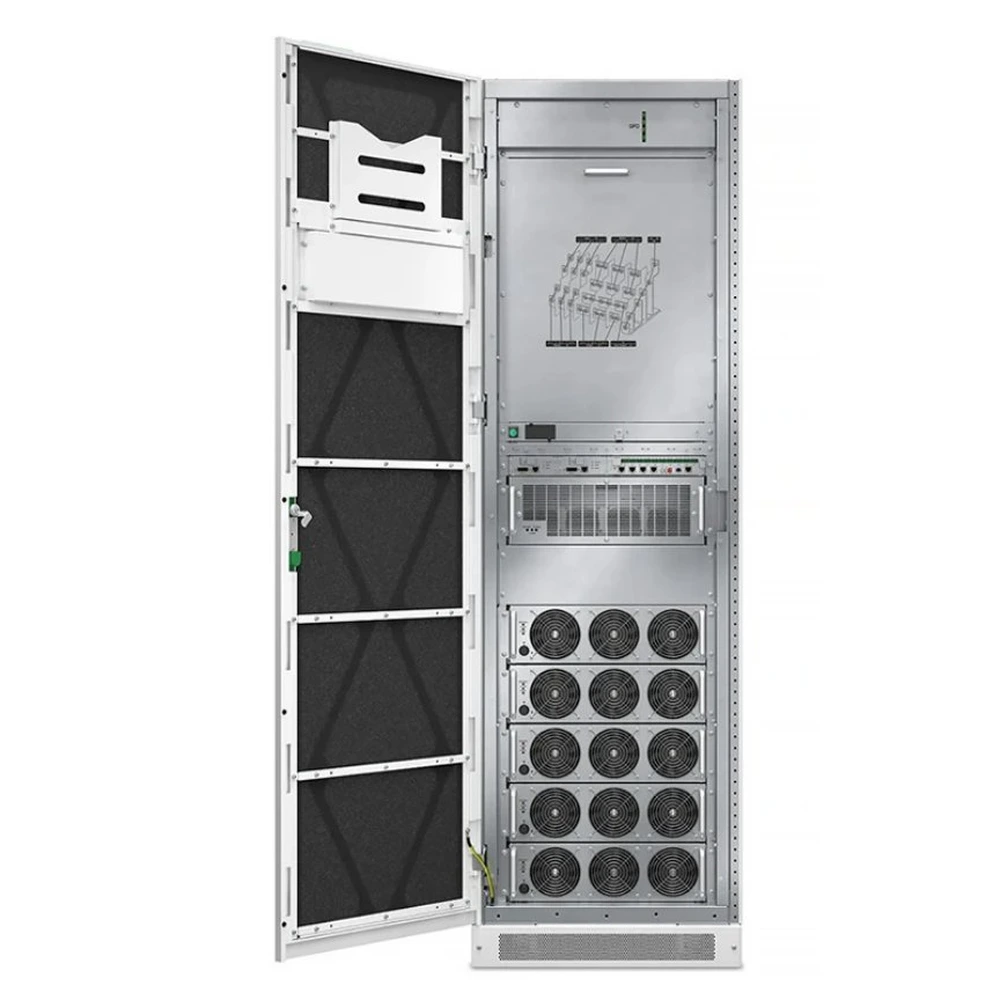
The input voltage range is 323 V to 477 V at full load, and overload tolerance is rated at 125% for ten minutes and 150% for one minute. The unit supports paralleling of up to five units for capacity scaling to 1,500 kVA or for N+1 redundancy. Total harmonic distortion on the input is below 3% at full load. Remote management is available through the EcoStruxure IT suite for cloud-based monitoring and smartphone access.
Physical dimensions are approximately 600 x 850 x 1970 mm with a net weight of about 450 kg. Noise level at one meter is 70 dB or less. Ingress protection is IP20. Certifications include IEC 62040-1, IEC 62040-2, CE, and RCM.
Technical Specifications
| Specification Item | Technical Detail (G3LUPS300KHTS) |
| Model Number | G3LUPS300KHTS |
| Rated Power (kVA/kW) | 300 kVA / 300 kW |
| Output Power Factor | 1.0 (Unity) |
| UPS Topology | Online Double Conversion |
| Nominal Input/Output Voltage | 380V / 400V / 415V (3-Phase) |
| Input Voltage Range | 323V – 477V (at full load) |
| Output Efficiency | 96% (Online) / 99% (ECO Mode) |
| Overload Capacity | 125% for 10 min / 150% for 1 min |
| Battery Configuration | External Battery System Required |
| Total Harmonic Distortion (THDI) | < 3% at full load |
| Dimensions (W x D x H) | Approx. 600 x 850 x 1970 mm |
| Net Weight | Approx. 450 kg |
| Noise Level at 1 Meter | ≤ 70 dB |
| Ingress Protection | IP20 |
| Certifications | IEC 62040-1, IEC 62040-2, CE, RCM |
Frequently Asked Questions
What does 300 kVA mean in a UPS?
300 kVA is the apparent power rating. With a unity power factor, it also means 300 kW of real power available to the load. This rating suits large data centers, commercial buildings, and industrial facilities with dense power demands.
Why choose an online UPS over a line-interactive model?
An online UPS feeds the load through the inverter at all times, so there is no transfer time during a grid disturbance. This provides the cleanest power and the best protection for sensitive or critical equipment.
What is double conversion in a UPS?
Double conversion means incoming AC is rectified to DC and then inverted back to AC. The load is electrically isolated from the grid, which eliminates voltage sags, swells, and harmonic distortion from reaching the equipment.
Can a 300 kVA UPS be expanded later?
Yes. The APC Galaxy 3L supports paralleling of up to five units, allowing capacity to scale to 1,500 kVA or N+1 redundancy to be added without replacing the original installation.
Does the APC Galaxy 3L 300kVA include internal batteries?
No. This model is supplied without internal batteries and is designed for connection to external battery cabinets. This allows runtime to be sized independently and simplifies battery maintenance.
Conclusion
Selecting a 300 kVA class UPS is a decision about topology, efficiency, scalability, and fault tolerance. Online double-conversion remains the reference for sites where power quality cannot be compromised. The APC Galaxy 3L 300kVA matches that requirement with unity power factor, up to 96% online efficiency, a wide input voltage range, and parallel scalability to 1,500 kVA. Its external battery architecture and front-access design add practical flexibility for facilities that need both protection and room to grow.
Looking for a high-density UPS for your data center, commercial building, or industrial facility? The APC Galaxy 3L 300kVA offers 300 kW of real power, online double-conversion protection, and scalable parallel operation. Contact our team to discuss your power requirements and backup runtime needs.