How to Choose a Reliable STS Static Transfer Switch for Data Centers
What Is an STS Static Transfer Switch
A Static Transfer Switch (STS) is a high-speed power switching device that provides single-corded equipment with access to two independent AC power sources. It continuously monitors the preferred power source and automatically transfers the connected load to an alternate source whenever it detects abnormal conditions such as voltage fluctuations, frequency deviations, or a complete power failure. Once the preferred source returns to normal, the STS can automatically switch the load back.Unlike traditional transfer switches that rely on mechanical contacts, an STS uses solid-state semiconductor devices, typically silicon-controlled rectifiers (SCRs), to complete switching within milliseconds. Because there are no moving parts, static transfer switches offer faster response, higher reliability, and lower maintenance requirements.STS units are widely used in environments where uninterrupted power is essential, including data centers, telecommunications facilities, financial institutions, healthcare systems, and industrial automation.
Why Data Centers Need an STS
Today’s data centers are designed around redundancy. Most facilities deploy dual power distribution systems supported by separate utility feeds, UPS systems, or backup generators to reduce the risk of downtime.However, not every piece of IT equipment includes dual power inputs. Many servers, storage systems, network switches, security appliances, and industrial controllers still rely on a single power cord. If their only power source fails, these devices can immediately shut down even though an alternative power source is available.
An STS solves this problem by acting as an intelligent bridge between two independent power sources and the connected equipment. When the preferred source experiences a fault, the STS transfers the load to the healthy source almost instantly, helping maintain continuous operation without manual intervention.By adding an STS, single-corded equipment can benefit from the same redundant power architecture normally available only to dual-input devices.
STS vs. Automatic Transfer Switch (ATS)
Although Static Transfer Switches (STS) and Automatic Transfer Switches (ATS) both switch loads between two power sources, they are designed for different applications.
A conventional ATS uses mechanical contactors or circuit breakers to perform the transfer. Mechanical movement requires significantly more time, with switching typically measured in hundreds of milliseconds or even several seconds. This performance is acceptable for many building electrical systems but is often too slow for sensitive IT equipment.
An STS, by contrast, performs switching electronically using semiconductor technology. Since there are no mechanical moving parts, transfer times are typically measured in just a few milliseconds. This speed is critical because many enterprise servers and networking devices can tolerate only a very short interruption before shutting down or rebooting.
For mission-critical environments where continuous power is required, an STS is generally the preferred solution.
Key Factors When Choosing an STS
1. Transfer Time
Transfer time is the most important performance indicator of an STS. It refers to the time required to detect a power abnormality and switch the connected load to the alternate power source.
Modern server power supplies usually have only a limited hold-up time. If the transfer takes too long, servers, storage devices, or networking equipment may restart unexpectedly, resulting in service interruptions or data loss.
When comparing products, look for an STS that provides switching within the hold-up capability of your equipment. Faster transfer times generally offer greater protection for critical applications.
2. Current Rating
Selecting the correct current capacity ensures stable operation under both normal and peak load conditions.
Common STS ratings include 10A, 16A, and 32A, making them suitable for a variety of rack-mounted equipment, network cabinets, and small power distribution systems.
When sizing an STS, calculate the total continuous load and allow additional capacity for future expansion. Operating well below the maximum rated current helps improve long-term reliability and reduces the risk of overload during temporary power surges.
3. Input Voltage and Frequency Compatibility
Power quality varies from one facility to another. Utility disturbances, UPS operation, generator switching, and load changes can all affect voltage and frequency.
A reliable STS should tolerate normal fluctuations without triggering unnecessary transfers. Before selecting a unit, verify its acceptable input voltage range, supported frequency, and tolerance to waveform distortion.
Choosing an STS with wide electrical compatibility helps ensure stable operation across different power environments and minimizes unwanted switching events.
4. Overload Capability and Efficiency
Temporary overload conditions may occur during equipment startup or fault events. A quality STS should be capable of handling these short-term increases while allowing downstream protective devices sufficient time to isolate the fault.Overload capability is therefore an important indicator of system reliability, especially in critical power applications.
Efficiency is another factor that directly affects operating costs. Since an STS operates continuously, even small improvements in efficiency can reduce heat generation, lower cooling requirements, and decrease energy consumption over the equipment’s service life.For data centers operating hundreds of power distribution devices, higher efficiency can contribute to noticeable savings over time.
5. Protection Features and Remote Monitoring
Beyond fast switching, modern STS units should include multiple protection and monitoring functions to improve system reliability.
Important features to consider include:
- Break-before-make switching, which prevents two power sources from being connected simultaneously and eliminates the risk of back-feeding.
- Fault isolation, ensuring downstream short circuits do not propagate to the alternate power source.
- DSP-based digital control, enabling faster detection of abnormal conditions and more accurate switching decisions.
- Remote monitoring capabilities, such as SNMP communication, allowing integration with Data Center Infrastructure Management (DCIM), Building Management Systems (BMS), or other monitoring platforms for real-time status, alarm notifications, and event logging.
These features not only improve operational reliability but also simplify maintenance and troubleshooting throughout the equipment lifecycle.
Why Choose the Vertiv STS 10A–32A Series
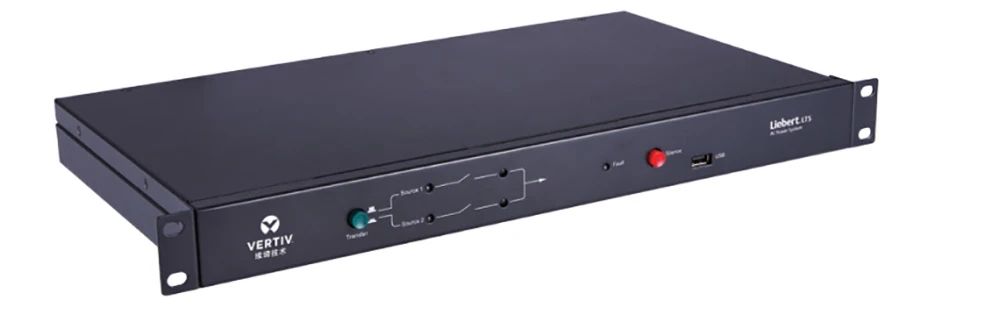
After identifying the key selection criteria, the next step is choosing a solution that combines fast switching, reliable protection, and flexible deployment. The Vertiv STS 10A–32A series is designed for single-phase critical power applications, offering high availability for servers, network equipment, storage systems, and other single-corded loads in data centers and IT facilities.
The series is available in 10A, 16A, and 32A models, allowing users to select the appropriate capacity based on actual load requirements while leaving room for future expansion.
Fast and Reliable Power Transfer
One of the biggest advantages of the Vertiv STS is its switching performance. It delivers a typical transfer time of less than 6ms and a maximum transfer time of less than 11ms, enabling connected equipment to ride through most power disturbances without interruption.
The unit continuously monitors both input sources and automatically transfers the load whenever the preferred source falls outside acceptable operating conditions. Once the primary source is restored, the STS can automatically switch the load back, maintaining continuous power with minimal interruption.
Wide Input Compatibility
To support a variety of power environments, the Vertiv STS offers broad electrical compatibility, including:
- Rated voltage: 220/230Vac
- Input voltage range: 150–300Vac
- Rated frequency: 50/60Hz
- Frequency tolerance: ±5Hz
- Maximum input voltage distortion: 10%
These specifications help the STS operate reliably during utility fluctuations, UPS bypass operation, and generator power transitions.
High Efficiency and Overload Protection
The Vertiv STS is designed for continuous operation with excellent energy efficiency.
Key performance specifications include:
- 99% efficiency at full load for 10A and 16A models
- 98% efficiency at full load for the 32A model
- 125% overload capability for 30 minutes
High operating efficiency minimizes power loss and reduces cooling requirements, while the overload capability provides additional protection during temporary surge conditions or downstream faults.
Advanced Protection and Intelligent Control
The Vertiv STS incorporates several features that improve overall system reliability.
The break-before-make switching design prevents two independent power sources from being connected simultaneously, eliminating the risk of back-feeding between sources.
Its DSP-based digital control system continuously analyzes input conditions and makes fast, accurate switching decisions. Compared with traditional analog control, DSP technology provides more precise monitoring and consistent performance.
To further improve availability, the unit also features redundant auxiliary power supplies for the control circuitry. Even if one auxiliary supply fails, the STS continues monitoring both input sources and remains capable of performing automatic transfers.
Remote Monitoring
For modern data centers, centralized monitoring is essential.
The Vertiv STS supports an optional SNMP communication card, allowing integration with DCIM, BMS, and network management platforms.
Operators can remotely monitor:
- Input source status
- Output voltage and current
- Transfer events
- Alarm information
- Operating status
This visibility helps maintenance teams quickly identify power quality issues and respond before they affect critical services.
Typical Applications
Because of its fast transfer capability and high reliability, the Vertiv STS is suitable for a wide range of critical power applications, including:
- Data centers and server rooms, protecting single-corded servers, storage systems, and network equipment.
- Telecommunications infrastructure, ensuring continuous operation of communication and transmission equipment.
- Financial institutions, where uninterrupted power is essential for trading platforms, transaction processing, and banking systems.
- Industrial automation, protecting PLCs, industrial servers, and control systems from unexpected power interruptions.
Conclusion
Choosing the right STS requires more than simply matching the current rating. Transfer speed, input compatibility, overload capability, protection features, monitoring options, and long-term reliability all play an important role in maintaining continuous power for critical equipment. Before making a final selection, evaluate your current load requirements, expected future expansion, installation space, and monitoring needs to ensure the chosen STS delivers the reliability and availability your power infrastructure demands.
The Vertiv STS 10A–32A series combines fast transfer performance, wide input voltage tolerance, high operating efficiency, intelligent DSP control, and comprehensive protection features in a compact solution for single-phase applications. Whether deployed in a data center, telecom facility, financial institution, or industrial environment, it provides dependable power redundancy for mission-critical loads. For more selection advice or technical documentation, please feel free to contact us anytime.