What Should You Consider When Choosing a 250kW UPS for a Data Center?
A data center depends on stable power to keep servers, storage systems, network equipment, and other critical infrastructure running. Even a short power interruption can affect IT operations, which is why a reliable uninterruptible power supply (UPS) is an important part of a data center’s power infrastructure.
For facilities with high power requirements, choosing a 250kW UPS involves more than simply checking the capacity on the nameplate. Buyers also need to consider the UPS topology, power factor, efficiency, voltage compatibility, battery configuration, overload capability, scalability, and maintenance requirements.
So, what should you look for when choosing a 250kW UPS for a data center?
Why Is a UPS Important for a Data Center?
The electrical supply to a data center needs to remain stable and available for critical equipment. Servers and network infrastructure cannot simply be shut down whenever there is a power interruption.
A UPS provides a layer of power protection between the facility’s electrical supply and its critical loads. Depending on the system design, it can help maintain power to connected equipment and provide time for the facility’s backup power strategy to take effect.
For larger data centers, the UPS itself also becomes an important part of the overall electrical infrastructure. This means the selection should consider both current operating requirements and future expansion.
What Should You Consider When Choosing a 250kW UPS?
1. Start With the Actual Power Requirement
The first question is simple: How much power does the UPS need to support?
A 250kW UPS is designed for a much larger load than the small UPS systems commonly used for individual computers, network devices, or small equipment rooms. Before selecting a system, the facility should understand the total power demand of the equipment that needs UPS protection.
It is also important to distinguish between kVA and kW. kVA represents the apparent power rating of the UPS, while kW represents active power.
For a UPS with a power factor of 1.0, the two values are directly aligned. A 250kVA UPS with PF=1.0 can therefore provide 250kW of active power.
For data center operators, this makes it easier to compare the UPS rating with the actual power requirements of the protected load.
2. Choose the Right UPS Topology
Not all UPS systems process incoming power in the same way. For critical data center loads, the UPS topology is an important consideration.
An online double conversion UPS continuously converts incoming AC power to DC and then converts it back to AC before supplying the connected load.
This approach allows the UPS to continuously process the incoming electrical power rather than simply switching to battery power when a problem occurs.
When evaluating ups double conversion systems, buyers should consider whether this topology matches the protection requirements of their critical loads.
For a data center, the key point is not simply choosing a UPS with a particular technical label. The topology should match the level of power protection required by the facility.
3. Check the Efficiency
A UPS operates as part of the data center’s electrical infrastructure, often for long periods. Therefore, efficiency should be considered alongside capacity.
A less efficient UPS can consume more energy during operation, and the additional heat generated can also increase cooling requirements.
For this reason, buyers should look at the UPS efficiency under the operating modes that are relevant to their facility.
For example, when comparing data center UPS solutions, it is useful to evaluate both normal online operation and any available energy-saving operating mode rather than looking at a single efficiency figure.
4. Confirm Input and Output Voltage Compatibility
The UPS must be compatible with the facility’s electrical system.
Before purchasing a 250kW UPS, buyers should confirm:
- Nominal input voltage
- Nominal output voltage
- Single-phase or three-phase configuration
- Acceptable input voltage range
- Compatibility with the existing electrical infrastructure
This is particularly important for large commercial and industrial facilities, where the UPS is integrated into a larger electrical distribution system.
A mismatch between the UPS specifications and the site’s electrical system can create installation and integration problems.
5. Consider the Battery Configuration
The UPS capacity tells you how much power the system can support, but it does not by itself determine how long the connected equipment can remain powered during an outage.
Backup runtime is closely related to the battery system.
For a large facility, an external battery configuration can provide greater flexibility because the battery system can be planned separately from the UPS cabinet.
When comparing UPS systems for data centers, buyers should therefore consider whether the UPS supports the battery configuration required by their backup strategy.
The battery type and configuration should be selected according to the required runtime and the overall power protection design.
6. Look at Overload Capability
Data center loads do not always remain at exactly the same power level. Temporary increases in load can occur, so overload capability is another specification worth checking.
A UPS with defined overload capabilities gives buyers a clearer understanding of how the system can operate when the connected load temporarily exceeds its normal rating.
Instead of looking only at the 250kW nominal rating, procurement teams should also check how much overload the UPS can support and for how long.
7. Think About Future Expansion
A data center’s power requirements may increase as more servers, storage systems, or other infrastructure are added.
For this reason, UPS scalability can be important during the initial purchase.
Parallel operation can allow multiple UPS units to work as part of the same power protection system. Depending on the design, this can be used to increase capacity or provide redundancy.
When evaluating a large UPS, buyers should therefore ask whether the system can support future expansion rather than considering only today’s load.
8. Consider Maintenance and Monitoring
A UPS is a critical part of the facility’s power infrastructure, so maintenance should be considered before installation rather than after a problem occurs.
Features such as front access, integrated breakers, and remote monitoring can make daily operation and maintenance easier.
Remote monitoring is particularly useful for facilities that need visibility into UPS operating status without relying entirely on local inspection.
Procurement teams should therefore evaluate not only the UPS’s electrical specifications but also how easily the system can be monitored and maintained over its operating life.
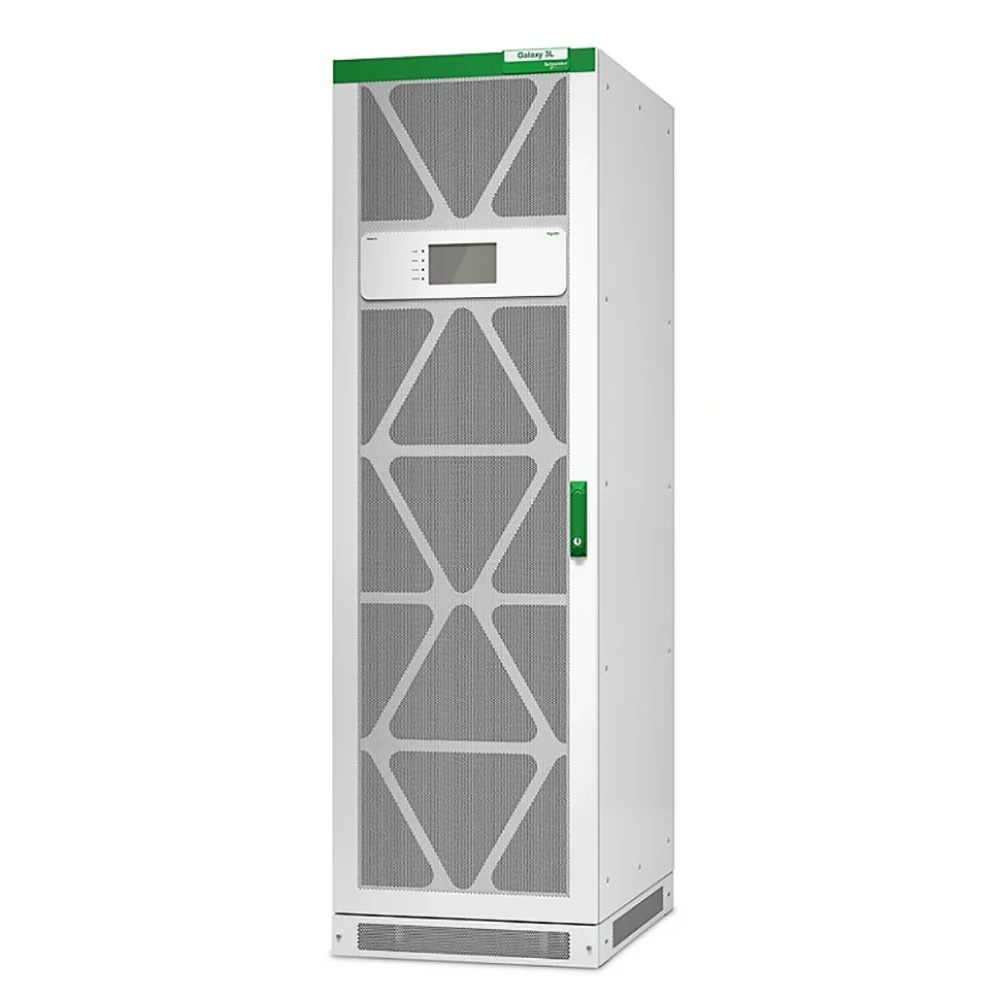
APC Galaxy 3L 250kVA/250kW UPS for Large Data Centers
The APC Galaxy 3L G3LUPS250KHTS is a three-phase UPS rated at 250kVA/250kW with a power factor of 1.0. It uses an online double conversion topology and is designed for medium and large facilities requiring high-capacity power protection.
250kVA/250kW Capacity With PF=1.0
The APC UPS has a 250kVA rating and a 1.0 output power factor, allowing it to provide 250kW of active power.
This makes the relationship between the UPS rating and the facility’s actual power demand straightforward.
Up to 96% Online Efficiency
The system provides up to 96% efficiency in online double conversion mode and up to 99% efficiency in ECO mode.
For facilities operating continuously, these efficiency figures can be considered when evaluating the UPS’s energy consumption and operating costs.
380V, 400V and 415V Three-Phase Support
The APC UPS supports nominal input and output voltages of 380V, 400V, and 415V in a three-phase configuration.
Its input voltage range is 323V to 477V at full load.
This allows the UPS to be evaluated against the electrical specifications of the intended installation site.
External Battery System
The G3LUPS250KHTS is supplied without an internal battery and uses an external battery system.
The product information specifies external VRLA or lithium-ion battery configurations, allowing the battery arrangement to be planned according to the facility’s backup requirements.
Overload Capability
The APC UPS supports:
- 125% load for up to 10 minutes
- 150% load for up to 1 minute
These specifications provide a clear reference for evaluating the system’s ability to handle temporary overload conditions.
Up to Five Units in Parallel
The system supports parallel connection of up to five units.
Depending on the facility’s design, parallel operation can be used for capacity expansion or N+1 redundancy.
This can be useful for data center operators planning for future growth or higher availability requirements.
Monitoring and Maintenance Features
The UPS is EcoStruxure™ IT Ready, allowing remote monitoring and management through Schneider Electric’s cloud-based platform.
It also includes built-in input, output, and bypass breakers and uses a front-access design for installation and servicing.
Compact Cabinet Design
The approximate dimensions are:
600 × 850 × 1970 mm
The approximate net weight is 415 kg.
The compact cabinet design can help facilities make better use of available floor space when integrating high-capacity UPS equipment into electrical rooms or data center environments.
Where Can a 250kW UPS Be Used?
A 250kW UPS is not limited to data centers. Its high power capacity also makes it suitable for other facilities with substantial critical loads.
Data Centers
It can be used for server farms, cloud storage environments, and enterprise IT infrastructure where continuous power protection is required.
Commercial Buildings
Potential applications include centralized HVAC systems, security infrastructure, and high-speed elevator systems in office buildings and commercial facilities.
Manufacturing and Industrial Facilities
Industrial applications can include automated production lines, CNC machinery, and control rooms.
Healthcare Facilities
The APC UPS can be used in hospital areas and diagnostic laboratories where reliable power protection is important.
Educational Institutions
Universities and other educational facilities can use high-capacity UPS systems for research laboratories and campus-wide IT networks.
Frequently Asked Questions About 250kW Data Center UPS Systems
What is a 250kW UPS?
A 250kW UPS is an uninterruptible power supply capable of providing 250kW of active power. The APC Galaxy 3L G3LUPS250KHTS is rated at 250kVA/250kW with an output power factor of 1.0.
What is the difference between kVA and kW in a UPS?
kVA represents apparent power, while kW represents active power. The relationship between the two depends on the power factor. With PF=1.0, 250kVA corresponds to 250kW of active power.
Why is online double conversion used in data centers?
Online double conversion continuously processes incoming AC power through AC-to-DC and DC-to-AC conversion before supplying the connected load. It is a common UPS topology for applications requiring continuous power protection.
Does the APC Galaxy 3L 250kVA have an internal battery?
The G3LUPS250KHTS is a without-internal-battery version and uses an external battery system.
Can the 250kVA UPS be connected in parallel?
Yes. The APC Galaxy 3L 250kVA supports parallel connection of up to five units for capacity expansion or N+1 redundancy.
Conclusion
Choosing a 250kW UPS for a data center requires a broader evaluation than simply comparing UPS capacity. The most important factors include actual load requirements, power factor, UPS topology, efficiency, voltage compatibility, battery configuration, overload capability, scalability, monitoring, and maintenance.
The APC Galaxy 3L 250kVA G3LUPS250KHTS provides a 250kVA/250kW rating with PF=1.0, online double conversion, up to 96% online efficiency, an external battery configuration, and parallel operation for up to five units.
By evaluating these specifications against the facility’s actual electrical requirements and future expansion plans, data center operators can make a more informed decision when selecting a high-capacity UPS system. If you are evaluating a 250kW UPS for your data center or large facility, contact our team to discuss your power requirements, battery configuration, and UPS system needs.