Why Is an Online Double-Conversion UPS Suitable for Sensitive Electronic Equipment?
Key Takeaways
- An online double-conversion ups power supply continuously converts incoming AC power to DC and then back to AC. This helps isolate connected equipment from many input-side power disturbances.
- Zero transfer time helps protect sensitive loads during a utility power failure. There is no interruption when the power source changes from utility power to battery power.
- Pure sine wave output and low voltage distortion make an uninterruptible power supplies ups suitable for equipment with active PFC power supplies and other sensitive electronic loads.
What Is Sensitive Electronic Equipment?
Sensitive electronic equipment requires a stable power supply with good continuity and power quality. Unlike ordinary electrical loads, these devices need more than continuous power. They also need stable and controlled voltage. Even a short power interruption, voltage fluctuation, or waveform distortion can affect normal operation.
Typical examples include servers, network and telecommunications equipment, industrial automation controllers, laboratory instruments, and some medical electronic equipment.
For example, a short power interruption may cause servers or network devices to restart. Industrial controllers may stop or lose control signals when the power supply becomes unstable. Laboratory or medical equipment may also be affected if power quality changes during operation.
How Does an Online Double-Conversion UPS Protect Sensitive Loads?
Sensitive electronic equipment needs both continuous power and stable power quality. When utility power fluctuates or fails, connected equipment may restart, lose control, or experience communication problems.
A UPS does more than provide battery power during an outage. It also helps maintain stable output while utility power is available.
An online double-conversion UPS does this through continuous double conversion and zero transfer time. The inverter already supplies power to the load during normal operation. Therefore, the UPS does not need to wait for a power failure before switching the load to the inverter.
1. Continuous Double Conversion Reduces the Impact of Utility Power Disturbances
The basic power path is:
AC utility power → rectifier → DC bus → inverter → AC load
During normal operation, the rectifier converts incoming AC power to DC. The inverter then converts the DC power back to AC for the load. As a result, the load receives power processed by the UPS rather than direct utility power.
This approach is useful for sensitive electronic equipment. Since the inverter continuously supplies the load, input-side voltage changes and other disturbances have less direct impact on the output.
An online double-conversion UPS therefore does more than provide backup power during an outage. It continuously processes incoming power during normal operation. The inverter then provides regulated AC output to the load.
When utility power fails, the battery immediately supplies energy to the DC bus. The inverter continues to supply AC power to the load. The power source changes inside the UPS, while the load continues to receive power from the inverter.
2. Why Is Zero Transfer Time Important for Sensitive Equipment?
During normal operation, the inverter already supplies power to the load. When utility power fails, the battery supplies energy to the DC bus. The inverter then continues to provide AC output without changing the load-side power path.
An online double-conversion UPS can provide zero transfer time. This is especially important for servers, network equipment, PLCs, industrial controllers, and laboratory instruments that cannot tolerate even a brief power interruption.
By keeping the output continuous, the UPS can help reduce the risk of equipment restarts, control interruptions, and work disruptions. This is one of the main reasons an online double-conversion UPS suits sensitive electronic equipment.
What Features Should an Online Double-Conversion UPS Have for Sensitive Electronic Equipment?
Sensitive electronic equipment needs more from a UPS than backup power during an outage. Servers, telecommunications equipment, industrial controllers, and laboratory equipment also require stable output and reliable power continuity.
When choosing an online ups 1kva, buyers should consider these requirements together with the UPS specifications.
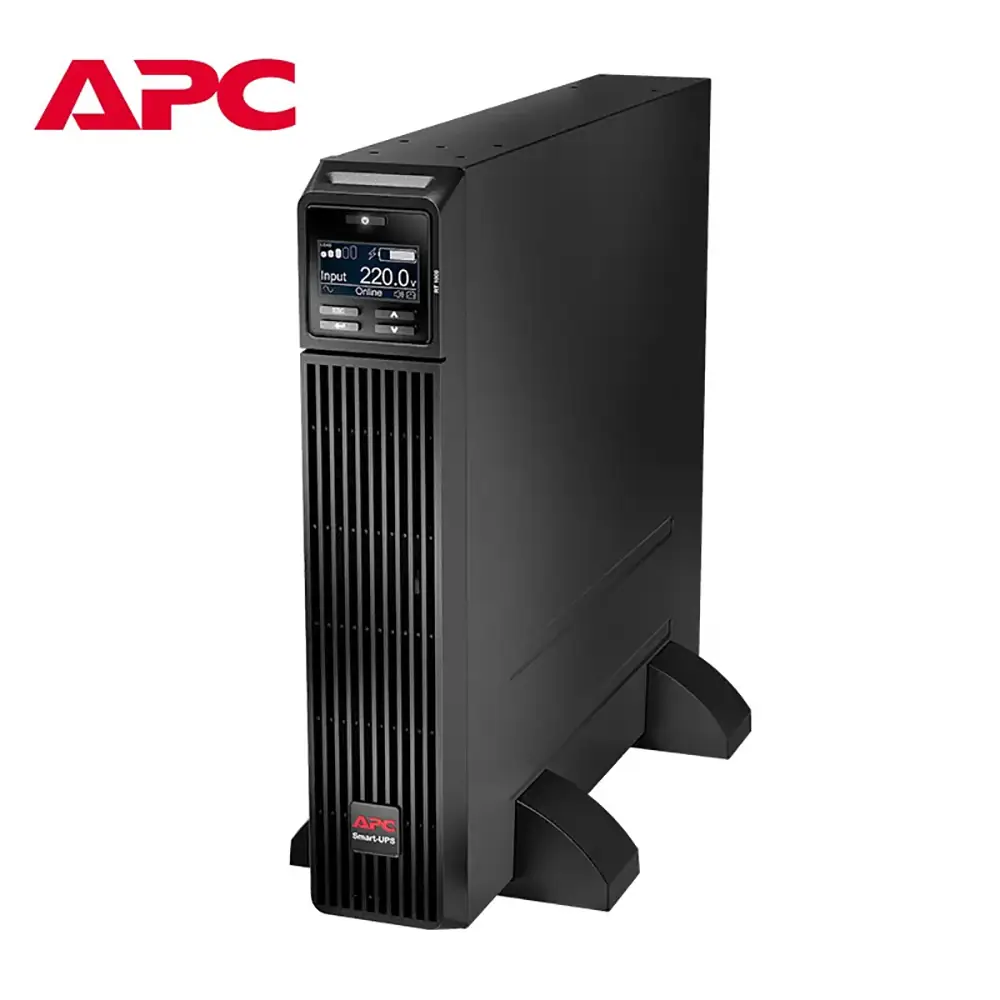
The APPLETON online double-conversion UPS is designed with these needs in mind. Its key features include the online double-conversion topology, output quality, input voltage range, and external battery option.
1. Online Double-Conversion Design Helps Keep the Load Running During a Utility Failure
The APPLETON UPS uses an online double-conversion topology. During normal operation, the inverter continuously supplies the load. If utility power fails, the battery takes over the DC bus supply. The inverter continues to provide power to the load.
The load therefore does not need to switch between utility power and battery power. This allows the UPS to provide zero transfer time. It also helps reduce the impact of a utility power failure on critical equipment.
2. Pure Sine Wave Output Supports Sensitive Loads
For sensitive electronic equipment, having power available is not enough. Servers, network equipment, and industrial electronics may also require stable voltage and a suitable output waveform.
The APPLETON online double-conversion UPS provides pure sine wave output. Under linear load conditions, its output voltage distortion is below 2%.
The UPS therefore provides more than backup power during an outage. During normal operation, the inverter continuously provides AC power that has been processed by the UPS.
This feature complements the double-conversion design. The rectifier processes incoming power, while the inverter provides AC output to the load. For servers and other sensitive equipment with active PFC power supplies, this type of output can provide suitable operating conditions.
3. A Wide Input Voltage Range Helps Reduce Unnecessary Battery Use
Utility voltage may vary at data centers, telecommunications sites, and industrial facilities. If a UPS switches to battery mode too often because of moderate voltage changes, battery capacity may be used unnecessarily.
The APPLETON 1kVA model supports a full-load input voltage range of 160–275 VAC. Within this range, it can continue normal operation without immediately using battery power because of moderate input voltage variations.
This can benefit servers, telecommunications equipment, and industrial controllers that need to run continuously. The UPS can handle a certain level of utility voltage variation. At the same time, it can reserve battery capacity for an actual power failure.
4. External Battery Configuration Allows More Flexible Backup Times
Zero transfer time helps prevent an immediate interruption when utility power fails. However, if the outage lasts longer, the UPS also needs enough battery capacity to keep the load running.
The APPLETON SURT1000UXI-CH uses an external battery configuration. It requires a 48VDC external battery and supports a maximum charging current of 6A.
This gives users more flexibility when they need longer backup times. The required external battery capacity can be selected according to the application.
For example, office equipment may only need short-term backup power. Telecommunications sites, remote installations, and some industrial applications may require a longer runtime. With an external battery configuration, users can choose the battery capacity that better matches their actual needs.
FAQ
Q1: What is the main difference between the SURT1000UXI-CH and SURT1000XLI-CH?
A: The SURT1000UXI-CH is the extended-runtime model. It does not include an internal battery and weighs 11.35 kg. It supports a maximum charging current of 6A, which allows faster charging of an external battery. The SURT1000XLI-CH has an internal battery, weighs 22.25 kg, and uses a standard 1.8A charger.
Q2: What external battery voltage does this UPS require?
A: The SURT1000UXI-CH requires a 48VDC external battery. One compatible option is the APC SURT48XLBP-CH extended-runtime battery pack.
Q3: Can this UPS be installed in a server rack?
A: Yes. It supports both rack and tower installation. With the SURTRK-CH rail kit, it can be installed in a standard 19-inch rack and occupies 2U of vertical space.
Q4: Does this UPS provide zero transfer time?
A: Yes. It uses an online double-conversion topology. The load does not need to switch between utility power and battery power when the utility supply fails. As a result, the UPS provides zero transfer time and helps maintain continuous power for critical equipment.
Q5: Can this UPS be connected to an emergency fire system?
A: Yes. The UPS includes an emergency power-off (EPO) interface. It can connect to an external fire or emergency alarm system. When an emergency shutdown signal is triggered, the UPS can shut down its output.
Conclusion
An online double-conversion UPS is well suited to sensitive electronic equipment because it provides continuous power conversion, zero transfer time, and stable output quality. These features can help reduce the effects of utility voltage changes and power interruptions on critical loads such as servers, telecommunications equipment, and industrial controllers.
APPLETON also offers pure sine wave output, low voltage distortion, a wide input voltage range, and an external battery configuration. These options make it easier to match the UPS with different load requirements and backup times.
If you need detailed specifications or a backup power solution for an ups 1000va or 1kva ups, contact APPLETON for product information and selection support. For the SURT1000UXI-CH, the team can also help you select an external battery configuration based on your required runtime.