750VA UPS Battery Backup Buyer’s Guide: How to Choose the Right Line-Interactive UPS for Your Application
Introduction
For network equipment, servers, NAS systems, POS terminals, and office equipment, power interruptions, voltage fluctuations, and transient surges can affect normal operation. For IT equipment that needs to remain running, a sudden outage can stop current tasks and may lead to data loss, abnormal shutdowns, or even equipment damage. The value of a UPS (uninterruptible power supply) is therefore not limited to keeping equipment powered during an outage. By providing battery backup, voltage regulation, and surge protection, a UPS creates a more stable power environment for connected equipment.
What Is a 750VA UPS Battery Backup?
A 750VA UPS battery backup is a UPS that normally supplies connected equipment with utility power and switches to its internal battery when the input power becomes abnormal or is interrupted. The “750VA” rating represents the UPS’s apparent power capacity, while its actual active power capability is also determined by its Watt (W) rating. Therefore, a 750VA UPS cannot simply be treated as a unit that can support any 750W load. The actual load must meet both the VA and W limits.
1. VA vs. W: How Should UPS Capacity Be Understood?
VA and W describe different aspects of UPS load capacity. VA represents apparent power and is related to the voltage and current requirements of the load. W represents active power, or the power actually consumed by the equipment. For equipment with switching power supplies, motors, or other nonlinear loads, the two values can differ significantly. When selecting a UPS, do not simply compare the wattage on an equipment nameplate with the UPS’s VA rating. Confirm the actual power requirements and make sure both the UPS’s VA and W ratings can support the load.
2. What Problems Can UPS Battery Backup Address?
The core function of a UPS is to provide a controlled backup power source when the input power is disrupted. During an outage, the UPS can use its internal battery to keep connected equipment running instead of allowing it to shut down immediately. For servers, NAS systems, and network equipment, this backup time can be especially useful because it provides time for a safe shutdown, data saving, or a backup power source to come back online. A UPS also needs to handle everyday power issues such as voltage fluctuations and transient disturbances.
Line-Interactive UPS vs. Online UPS
Both line-interactive and online UPS systems can provide backup power, but they handle incoming power differently. Understanding this difference is an important step when deciding which UPS architecture fits an application.
1. How Does a Line-Interactive UPS Work?
A line-interactive UPS normally uses utility power directly to supply the load when the mains supply is stable. At the same time, it uses AVR (automatic voltage regulation) to adjust voltage fluctuations within a certain range and help maintain a stable output voltage.
If the input voltage moves beyond the AVR’s adjustment range or the utility power fails, the UPS switches to battery mode. The battery and inverter then continue supplying power to the load. Because the inverter does not need to continuously convert the power while utility power is available, the line-interactive design uses a relatively simple power conversion process.
2. How Does an Online UPS Work?
An online UPS typically uses a double-conversion design. The incoming AC power is first converted to DC and then converted back to AC by the inverter, which continuously supplies power to the load.
Because the inverter is always operating, changes in the input voltage and frequency are processed and regulated before the power reaches the connected equipment. Compared with a line-interactive UPS, an online UPS provides a more continuous power conversion process, but its system design is also more complex.
3. Which UPS Topology Is Right for Your Application?
If the application mainly involves voltage fluctuations, power outages, or surge risks, a line-interactive UPS is usually a practical choice. It provides basic power protection for network devices, office equipment, POS systems, and entry-level IT equipment. It uses AVR to handle a certain range of voltage changes and provides battery backup during an outage without the continuous double-conversion process of an online UPS.
If the load is part of critical infrastructure or has higher requirements for power quality, isolation, and continuous power delivery, an online UPS may be worth considering. Procurement teams should not choose one simply because “online” sounds like a higher level of protection. The better approach is to assess the actual power environment and the sensitivity of the equipment, then determine whether the additional UPS architecture provides meaningful value.
| Comparison | Line-Interactive UPS | Online UPS |
| Typical architecture | AVR + battery backup | Double conversion |
| Voltage regulation | Through AVR | Continuous power conversion and regulation |
| Typical applications | Network equipment, office equipment, retail, entry-level IT | Critical IT equipment and power-sensitive loads |
| Efficiency considerations | Typically offers higher operating efficiency | Double conversion introduces some conversion losses |
| Cost | Usually more economical | Usually higher |
| Main selection focus | Power protection with a balance of cost and efficiency | Higher power-quality requirements |
Why Choose the APC Smart-UPS SMT Series SMT750I-CH 750VA/500W Line-Interactive Tower UPS?
For applications that need backup power for network equipment, office IT systems, retail terminals, or small servers, the SMT750I-CH is not intended to use a more complex architecture for every application. Instead, it combines a line-interactive topology, pure sine wave output, AVR, and battery backup to balance practical protection needs with equipment cost.
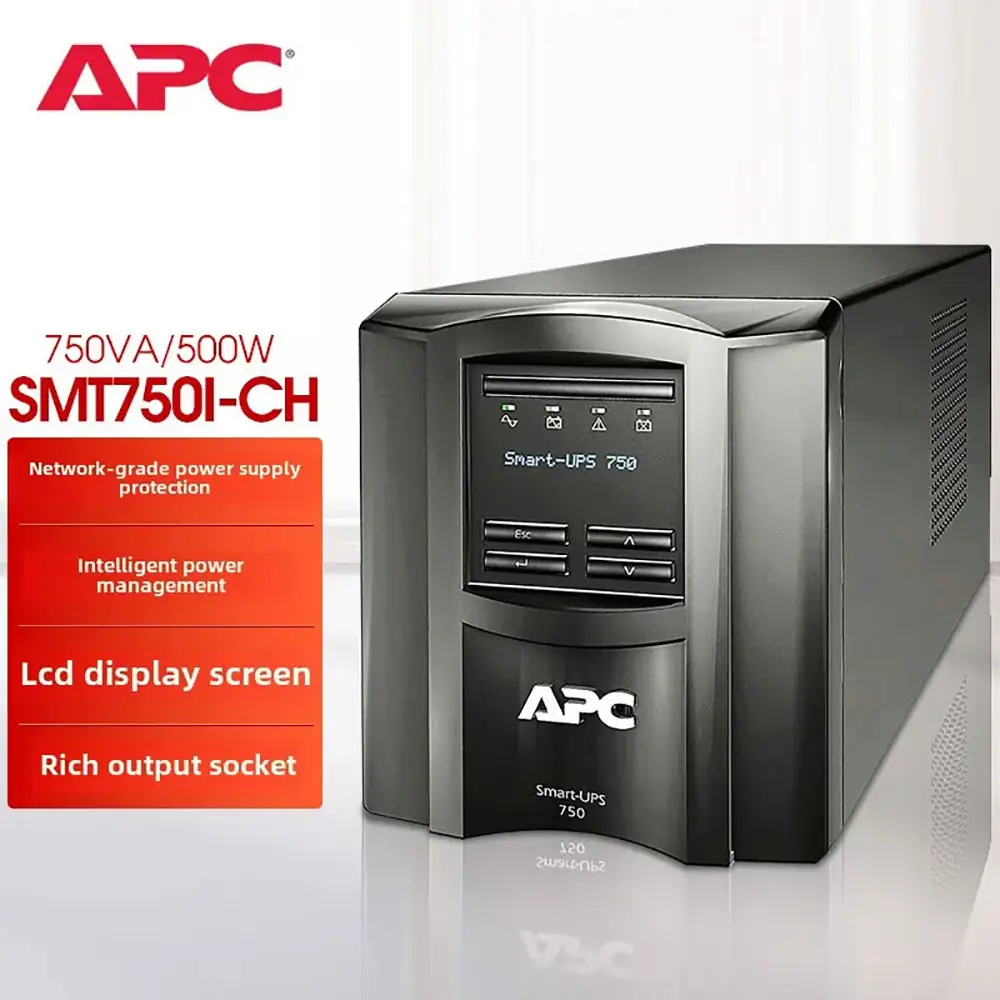
1. Key Technical Specifications of the SMT750I-CH
| Technical Parameter | SMT750I-CH |
| UPS topology | Line-interactive |
| Rated capacity | 750VA / 500W |
| Output waveform | Pure sine wave |
| Output voltage distortion | <5% at full load |
| Input voltage range | 160V–287V |
| Surge protection | 540 J |
| Maximum efficiency | Up to 96% |
| Battery type | Sealed maintenance-free VRLA lead-acid battery |
| Typical runtime at half load | Approx. 16 minutes |
| Typical runtime at full load | Approx. 4.6 minutes |
| Output outlets | 6 × IEC 320 C13 |
| Communication | SmartSlot™, USB, serial |
| Dimensions | 157 × 138 × 358 mm (H × W × D) |
| Net weight | 13.15 kg |
| Packaged weight | 14.23 kg |
2. 750VA/500W Rated Capacity and Actual Load Matching
The SMT750I-CH is rated at 750VA/500W, so buyers can evaluate the load in terms of both apparent power and active power. For routers, switches, modems, PBX systems, NAS devices, entry-level servers, and POS equipment, do not choose a UPS based only on the number of devices. Calculate the total load instead. Make sure it stays within the UPS’s rated capacity.
This capacity is also suitable for applications that need local battery backup for key equipment without requiring a large UPS system. As long as the actual load is properly calculated, the 750VA/500W rating can serve as an independent power protection unit for small network and IT systems while leaving some room for future load changes.
3. Pure Sine Wave Output and Equipment Compatibility
The SMT750I-CH provides pure sine wave output, delivering an AC waveform that is closer to standard utility power when the UPS is operating in battery mode. For servers, workstations, and some sensitive electronic equipment using active PFC power supplies, pure sine wave output can help improve compatibility between the UPS and the equipment’s power supply system. It is therefore an important specification to consider when selecting a professional UPS. The model also has output voltage distortion below 5% at full load.
4. SmartSlot Communication and Tower Design
For IT environments that require remote UPS management, the SMT750I-CH includes a SmartSlot™ communication card slot, along with USB and serial communication interfaces. SmartSlot can be used with a compatible network management card to extend remote monitoring and control capabilities. This allows the UPS to be integrated into a broader IT power management system rather than operating only as a standalone power device.
The model uses a tower configuration and measures 157 × 138 × 358 mm (H × W × D), with a net weight of approximately 13.15 kg. It provides six IEC 320 C13 output outlets, so up to six devices can be physically connected. The actual number of supported devices still depends on the total load and the plug and outlet requirements of each device. This configuration provides a practical balance of capacity, connectivity, and footprint for office, retail, and small IT environments.
FAQ
Q1: What type of output waveform does the SMT750I-CH provide?
The SMT750I-CH uses a line-interactive UPS topology and provides pure sine wave out put.In battery mode, the UPS provides a pure sine wave output that closely matches standard utility power. This makes it suitable for IT equipment with active PFC power supplies.
Q2: How many devices can this UPS support?
The SMT750I-CH has six IEC 320 C13 output outlets, so up to six devices can be physically connected. However, the actual number of supported devices must also take into account the total VA/W load and the plug and outlet requirements of each device.
Q3: How long can the UPS provide backup power?
The model uses a built-in sealed maintenance-free VRLA lead-acid battery. Its typical runtime is approximately 16 minutes at half load and 4.6 minutes at the full 500W load. Actual runtime varies with the load, so the application should be evaluated based on the connected equipment and the required time for safe shutdown or short-term backup power.
Q4: Can I add a network management card to this model?
Yes. The SMT750I-CH includes an APC SmartSlot™ communication card slot that can accept a compatible network management card to extend remote UPS monitoring and management. This can provide more flexible device management in server rooms, network environments, or applications that require centralized UPS monitoring.
Q5: What are the dimensions and weight of the SMT750I-CH?
The model measures 157 × 138 × 358 mm (H × W × D), with a net weight of approximately 13.15 kg and a packaged weight of approximately 14.23 kg. Its tower design can be placed near the equipment without requiring additional rack space, making it suitable for offices, retail locations, and small IT environments.
Conclusion
When selecting a 750VA UPS battery backup, the key consideration is not the “750VA” number alone. The UPS’s rated capacity must match the actual load, while its output waveform, voltage regulation, battery runtime, and management functions must also meet the application requirements. Line-interactive UPS systems work well for many common applications, from network and office equipment to retail and entry-level IT devices. For critical loads, an online UPS is often a better choice when higher power quality is required. The right approach is to define the application first and then select the appropriate UPS topology, avoiding both undersizing and unnecessary overconfiguration.
For businesses purchasing a 750VA UPS, the final decision should come back to the actual project: How much is the load? How much backup time is needed? What is the local power environment? What output waveform does the equipment require? Is remote management necessary? Once these requirements are clear, the SMT750I-CH technical specifications can be matched to the application to support a more reliable purchasing decision and avoid choosing a UPS based only on price or VA rating.