How to Select a 1000kW UPS for High-Load Power Protection
Key Considerations
· Selecting a 1000kW-class UPS should start with the actual protected load. Key factors include the load profile, peak demand, redundancy requirements, input and output conditions, battery configuration, and future expansion plans.
· Capacity is only one part of the selection process. The right APC UPS should also match the required topology, operating mode, power factor, modular architecture, maintenance strategy, and future growth.
· Common UPS topologies, such as Online Double Conversion, should be evaluated against the required level of power quality and protection. High-efficiency operating modes should also be considered in relation to load characteristics, operating hours, and energy-efficiency targets.
· During procurement, the UPS should be configured around the project’s actual requirements. Use the RFQ process and technical specification sheet to verify key parameters rather than choosing a product based only on its nameplate rating.
Why Can’t You Select a 1000kW UPS Based on Rated Capacity Alone?
Once the load has been assessed, the next step is to confirm whether the proposed UPS configuration can meet the project requirements. Start with the required capacity. Then determine whether additional capacity is needed for redundancy.
For a UPS with an output power factor of 1.0, kVA and kW are equivalent, which makes capacity calculations more straightforward. If a different power factor applies, check the required capacity against the actual load power.
For critical applications, it is also important to determine whether N+1 or N+X redundancy is required. A UPS may have enough capacity under normal conditions, yet still lack sufficient capacity during maintenance or a partial failure.
For this reason, selecting a 1000kW UPS should not be based on rated power alone. First determine the actual load. Then establish the required capacity and redundancy level. The operating mode, battery configuration, and future expansion capability can be evaluated afterward.
This approach avoids selecting a UPS simply because its rated capacity is close to the current load. More importantly, it provides a clearer basis for matching the configuration to actual operating conditions.
How Should You Select the UPS Operating Mode Based on Load and Operating Requirements?
1. When Is Online Double Conversion the Right Choice?
Online Double Conversion UPS systems keep the inverter continuously supplying the protected load. The incoming power passes through the online UPS before reaching the connected equipment. This helps maintain a stable and controlled output.
This operating mode is worth considering when power quality and continuity are critical. It is particularly relevant to data centers and industrial facilities, where voltage fluctuations or other power disturbances could affect sensitive equipment or interrupt operations.
When evaluating Online Double Conversion, consider the site’s power conditions and the criticality of the load. The required level of power protection should also be taken into account rather than comparing efficiency figures alone.
2. When Should a High-Efficiency Operating Mode Be Considered?
For UPS systems that operate under high loads for extended periods, efficiency can directly affect energy consumption. Higher efficiency generally means less energy is lost inside the UPS. It also means less heat is generated during operation.
A high-efficiency operating mode is therefore worth considering for projects with long operating hours and a strong focus on energy consumption and operating costs. However, the highest efficiency figure should not be the only selection criterion. The operating mode must suit the site’s load characteristics and meet its power protection requirements.
The goal is not simply to decide which operating mode is “better.” Instead, select the mode that best fits the application.
For critical loads where continuous and stable power protection is the priority, Online Double Conversion may be the preferred choice. If the UPS operates for long periods and energy efficiency is a major concern, a high-efficiency operating mode may be worth evaluating.
The final decision should be based on the actual load and overall configuration. This ensures that the selected operating mode is appropriate for the application.
Why Is a Modular Architecture Important for a 1000kW-Class UPS?
1. How Does a Modular Architecture Improve Capacity Planning?
In a 1000kW-class UPS, a modular architecture divides the system into standardized power units. This avoids the need to install the full capacity as a fixed configuration from the beginning.
This approach is particularly useful for facilities that are built in phases or expect power demand to increase over time. The initial UPS configuration can be sized for the current load. Additional capacity can then be added as demand grows.
When evaluating a modular UPS, do not look only at the total rated capacity. Check the capacity of each power unit as well as the maximum system capacity supported by the architecture. These figures provide a more practical basis for planning the initial installation and future expansion.
2. How Does Modular Design Affect Maintenance and Redundancy?
Modular architecture also affects maintenance and availability.
For critical applications, normal operating capacity is only part of the equation. The UPS must still support the required load when a module is unavailable because of a fault or scheduled maintenance.
Redundancy configurations such as N+1 or N+X should therefore be considered during the initial planning stage. Procurement teams should clearly distinguish between the required operating capacity and the reserved capacity for redundancy.
This helps prevent a situation in which the UPS appears adequately sized based on its nameplate rating but cannot provide enough capacity during maintenance or a module failure.
3. How Can a Parallel UPS System Support Larger Capacity Requirements?
When a single 1000kW UPS cannot provide enough capacity for future demand, multiple UPS systems can be connected in parallel to increase the overall capacity.
This can give large facilities more flexibility as their power requirements grow. However, usable capacity depends on the site’s electrical distribution architecture, redundancy strategy, and overall design. It should not be calculated simply by adding the rated capacities of multiple units.
For large-scale power protection, consider modular architecture, redundancy, and parallel operation together. Modular architecture supports flexible capacity planning. Redundancy helps maintain capacity when individual modules are unavailable. Parallel operation provides a scalable path for future expansion.
Why Choose Apton Power’s Galaxy VX Solution?
1. Product Fit
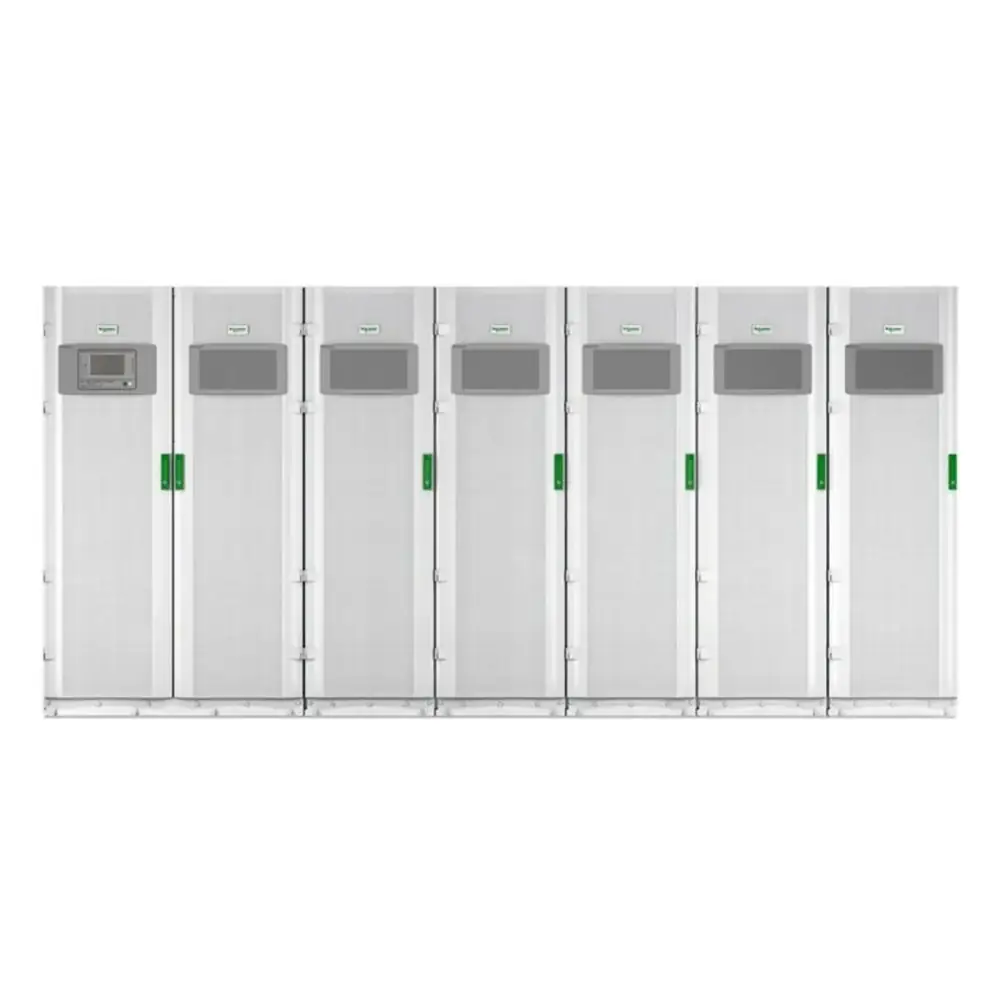
Apton Power offers the Schneider Galaxy VX UPS in 1000kW, 1250kW, and 1500kW configurations. The system uses 250kW power cabinets, provides an output power factor of 1.0, and supports both Online Double Conversion and ECOnversion™ operating modes. It also supports N+1 and N+X redundancy.
For projects with defined load profiles, operating strategies, and reliability requirements, these specifications provide a clear basis for evaluation. They help determine whether a Galaxy VX configuration is suitable for the application.
2. Matching Technical Specifications to Project Requirements
The Galaxy VX also provides key technical specifications that can be used to evaluate its suitability for different project requirements.
| Specification | Galaxy VX |
| Power Capacity | 1000kW / 1250kW / 1500kW |
| Modular Architecture | 250kW Power Cabinets |
| Output Power Factor | 1.0 |
| UPS Topology | Online Double Conversion / ECOnversion™ |
| Online Efficiency | Up to 97% |
| ECOnversion™ Efficiency | Up to 99% |
| Redundancy | N+1 / N+X |
| THDi | < 3% at Full Load |
| Parallel Capability | Up to 4000kW |
These specifications give procurement teams a clear basis for evaluating the UPS against actual project requirements. Key factors include site voltage, battery configuration, load size, efficiency targets, and future expansion plans.
The key is to evaluate the complete configuration rather than focus on a single specification.
3. Procurement Support and Configuration Confirmation
For a 1000kW-class UPS, selecting the equipment is only the beginning. The more important question is whether the proposed configuration fits the actual site conditions.
Apton Power provides Galaxy VX UPS solutions and can work with customers to confirm requirements such as UPS capacity, load characteristics, voltage, redundancy, and battery configuration.
This allows procurement teams to define their actual power requirements before selecting the equipment. It also avoids making a decision based only on the product name or rated capacity.
This is particularly important for large-scale projects. Two UPS systems may both be rated at 1000kW. However, their recommended configurations can differ depending on the load profile, redundancy requirements, site voltage, and battery technology.
Clarifying these requirements before issuing an RFQ provides a stronger basis for technical and commercial evaluation than simply asking for the price of a “1000kW UPS.”
FAQ
1. Is a 1000kW UPS suitable for every 1000kW load?
Not necessarily. Proper sizing depends on the actual protected load, redundancy requirements, operating mode, battery strategy, and future expansion plans.
The 1000kW nameplate rating should therefore be treated as a starting point for configuration rather than a complete sizing conclusion.
2. What Is the Difference Between Online Double Conversion and ECOnversion™?
According to the specifications provided, Online Double Conversion offers efficiency of up to 97%, while ECOnversion™ can achieve efficiency of up to 99%.
Online Double Conversion uses a four-level inverter topology as part of its standard online operating mode. ECOnversion™ is designed to provide higher operating efficiency.
The appropriate mode should ultimately be selected according to the site’s power quality requirements, load characteristics, and efficiency priorities.
3. Why Is a 250kW Modular Architecture Suitable for a 1000kW-Class UPS?
A 250kW modular architecture provides clearly defined power units within the overall UPS configuration. This allows capacity to be planned in smaller increments. It also makes redundancy and future expansion easier to evaluate.
The final configuration should still be determined according to the project’s actual load and requirements.
4. What Information Should Be Included in a 1000kW UPS RFQ?
At a minimum, an RFQ should include the required protected load, target UPS capacity, and redundancy requirements. It should also specify the input and output voltage, intended operating mode, battery technology, ambient temperature, future expansion needs, and the specific application.
It is also recommended to request a technical specification sheet or MTC. This allows the proposed configuration to be reviewed before commercial quotations are compared.
Conclusion
Selecting a 1000kW UPS for high-load power protection is ultimately a configuration decision. It is not simply a matter of choosing a larger UPS.
The selection process should start with the protected load and the required level of redundancy. It should also account for the operating mode, modular architecture, battery configuration, electrical interfaces, monitoring requirements, and future capacity needs.
For the Galaxy VX solution discussed in this guide, several configurations are available, including 1000kW, 1250kW, and 1500kW models. The solution supports 250kW modular power cabinets, a 1.0 output power factor, Online Double Conversion, and ECOnversion™ efficiency of up to 99%. It also offers N+1/N+X redundancy, multiple battery technology options, and parallel operation up to 4000kW. Together, these specifications provide a clear technical basis for evaluating large-scale UPS requirements.
Planning a 1000kW UPS for a data center, industrial facility, or other high-load application?
Submit an RFQ with your load requirements, input and output voltage, redundancy requirements, battery technology, and future expansion plans. Apton Power can review the project conditions, confirm a suitable Galaxy VX configuration, and provide the corresponding technical specification sheet (MTC) for further evaluation.